CRWD long intact
CrowdStrike Holdings, Inc.
CrowdStrike: Great Company, Bad Time to Buy
Thesis
- One of the strongest businesses in cybersecurity: $5.40 billion of revenue grew 24.3% over the last twelve months, 29.8% of it kept as free cash flow, and growth has sped up five quarters in a row (19.8% to 25.8%).
- The price already assumes nearly everything goes right: 49.8 times sales against a peer average of 15.6, and still 55 times cash after five years of 25% growth.
- At a record $266.09 it trades 13% above the $235.67 average analyst target and 21% above its 50-day average, with RSI at 68 and new highs on about half the volume.
- Plan: hold cash and buy only on a pullback to $235 to $247, with RSI back in the 50s.
Kill criteria
What would prove this thesis wrong:
- Price falls below the 50-day moving average, near $220. That would mean the uptrend is breaking, and I would sell.
I wouldn’t buy CrowdStrike at $266 right now, and I think it should go on the watchlist with an entry zone of $235 to $247. The business is actually one of the strongest in cybersecurity, but the stock isn’t cheap at about 50 times its yearly sales and it already trades 13% above the $235.67 price that analysts think it’s worth on average. The stock is still going up but it has gone up really fast, so I think waiting for the price to dip makes more sense than buying at a record high.
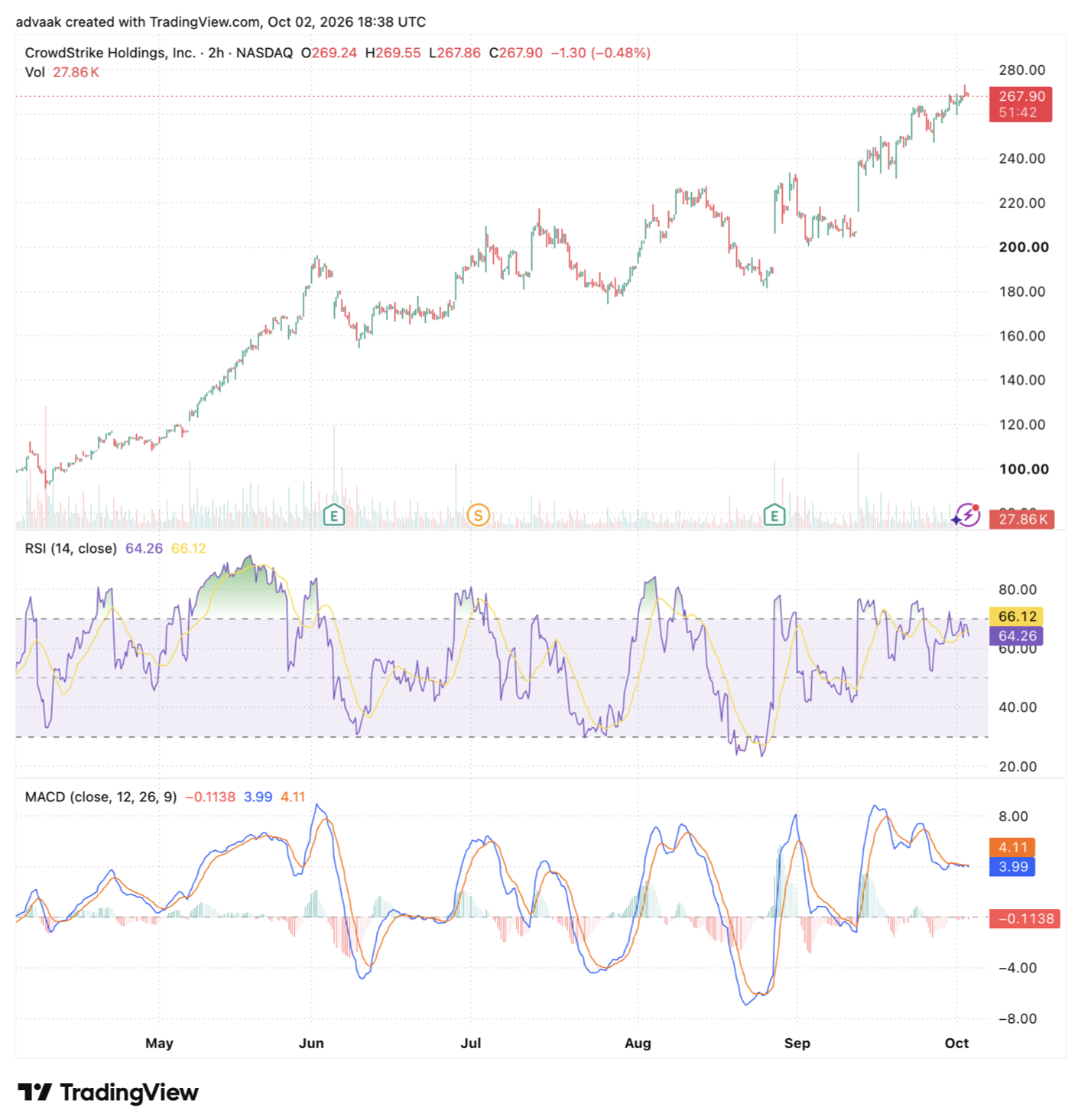
CRWD on 2-hour candles (NASDAQ) with volume, RSI (14) and MACD (12, 26, 9), as of October 2, 2026, 18:38 UTC. Chart made by the author on TradingView. The RSI and MACD figures in the text are calculated from daily closes through October 1, so they differ from this 2-hour view.
What CrowdStrike does
CrowdStrike sells security software that protects a company’s computers from hackers. Its product is called Falcon, and it’s a small program installed on every laptop and server that watches for attacks. Companies pay for it as a subscription, so almost all of the revenue repeats every year, and subscriptions were $1.40 billion of the $1.47 billion in revenue last quarter. It grows mostly by selling more add-ons to the customers it already has, and 51% of customers now pay for six or more of them.
The industry
The industry is in a good spot too. The research firm Gartner expects companies to spend $246.2 billion on security in 2026, up 12.2%, so CrowdStrike is growing about twice as fast as the industry. I think it helps that companies want to buy their security from fewer vendors, and that they are starting to use AI tools that hackers can attack so there is more to protect.
Against its peers
To compare it with competitors I looked at Palo Alto Networks, Fortinet, Zscaler and SentinelOne using the last twelve months of numbers. CrowdStrike’s revenue of $5.40 billion grew 24.3%, which is close to Palo Alto (24.5%) and Zscaler (25.4%) and ahead of SentinelOne (21.1%) and Fortinet (18.8%). It keeps 29.8% of its revenue as free cash flow, which is the cash left after running the business, and the competitor average is 27.0%. So on growth and cash it’s a little better than average but not by a lot.
The big difference is the price of the stock. If you divide what the whole company is worth by its yearly sales, CrowdStrike costs 49.8 times sales, compared with 28.8 for Palo Alto, 17.0 for Fortinet, 9.2 for Zscaler and 7.2 for SentinelOne. That is more than three times the average of 15.6, and I think investors are paying that much because its growth keeps getting faster.
| Company | Revenue growth, last 12 months | Value ÷ sales |
|---|---|---|
| CrowdStrike | 24.3% | 49.8× |
| Palo Alto Networks | 24.5% | 28.8× |
| Fortinet | 18.8% | 17.0× |
| Zscaler | 25.4% | 9.2× |
| SentinelOne | 21.1% | 7.2× |
The financials
Over the last twelve months, ending July 31, 2026, revenue was $5.40 billion and free cash flow was $1.61 billion. Growth has gotten faster for five quarters in a row, from 19.8% in the quarter that ended April 2025 to 25.8% in the latest one. The weak spot is profit, since under the official accounting rules it only made about $45 million for the year. The main reason is that it pays employees a lot in stock, which creates new shares, and the number of shares went up 3.2% over the year.
I’m not worried about solvency, which is just whether the company can pay its debts. CrowdStrike has $5.01 billion of cash and only $0.82 billion of debt, and it could pay off everything it owes with about six months of free cash flow. Its debt is 0.16 times its equity compared with a competitor average of 0.29.
Latest news
The most recent news is the earnings report on August 26, which management called the best quarter in company history. Revenue rose 26% to $1.47 billion, and it added a record $333 million of new subscription revenue, which is 51% more than it added a year ago. Management raised its revenue forecast for the full year to $5.99 to $6.01 billion and the stock gained 20.5% the next day. It jumped another 13.9% on September 14 when news about the risks of AI made investors buy security stocks.
Spending
For spending, the company put $408 million into things like equipment over the last twelve months, which is about 7.6% of revenue, and the $2.02 billion of cash it made from operations covers that about five times. It also spent $175.6 million buying back its own stock in the first half of the fiscal year. All of this is paid for with cash the business makes and not with debt, so I think the spending fits with its revenue and free cash flow.
Valuation
For the stock price, CrowdStrike closed at a record $266.09 on October 1 and it’s up about 115% over the past year. I don’t think the stock is underestimated. To test it I assumed revenue keeps growing assume 25% a year for five years , which gets it to about $16.5 billion, and that assume 30% of that turns into cash , which is about $4.9 billion. Even then the company’s value today would be 55 times that cash. So basically the price already assumes five more years of almost everything going right, and the average analyst price target of $235.67 is below where the stock trades.
Technicals
On the technicals the trend is strong but the price has gotten ahead of itself. The stock is 21% above its 50-day moving average of $219.79, so it’s clearly in an uptrend but far above where buyers usually step in. The 14-day RSI is 68, and anything over 70 is considered overbought. MACD is still positive, but the gap between the MACD line and its signal line has gotten smaller every day since September 23, which tells me the upward push is getting weaker.
Volume says the same thing. When the stock jumped between September 14 and 23 it traded 15.2 million shares a day on average, and over the last five days it averaged 7.9 million. So the stock is making new highs on about half the volume, and I don’t think many new buyers are coming in.
The plan
So the fundamentals say it’s a great company and the technicals say it’s a bad time to buy. I would hold cash and only buy if the price drops back to $235 to $247, which is where it traded right after the mid-September jump, and I would want RSI back in the 50s. If it fell below the 50-day average near $220 I would sell, because that would mean the uptrend is breaking. The stock dropped 12% in two days after August 31 even after a record quarter, so I think a dip like that could happen again.
Sources
For sources I used CrowdStrike’s latest earnings press release, StockAnalysis for the financial and competitor numbers, and a summary of Gartner’s 2026 security forecast. I calculated the RSI, MACD and volume averages from daily closing prices between July 24 and October 1, 2026.